Six of Swords: Science

ThothRider-Waite

Science: (The Search for) Truth, Progress, and Unity

The Six of Swords. Science. Progress. Unity. Achievement. Truth. Logic. Discovery. Order. Moral and Mental Balance. The Six of Swords corresponds to the Sefirot of Tiphareth: Experience and the Conscious Harmony. Science resolves the conflict between Chesed and Geburah, and restabilizes the energy of the Suit of Swords. The Truth is restored from the effects of Defeat, and Peace is restored, allowing for the furthering of Science. Science is the best that the Suit of Swords has to offer, and represents the balanced energy of the Suit. It is the ultimate of the conscious harmonies, as this card represents the hunt for the truth of the universe, guided from above by the influence of Kether. It is the ultimate positive manifestation of the ideals of the Suit of Swords: the intellectual pursuit of Truth to be used in the name of Justice. It is the ultimate in abstract thought.

This card, then, represents the discovery and progress associated with Science, as well as the unity that comes with throwing off the shackles of defeat and re-achieving Peace. It represents the intellectual achievements that lead to the world becoming a better place, often attained through the application of Logic. This card represents also the balance between morality and one’s mental state; the two both must be in prime condition to effectively pursue Science.

The Rider-Waite art shows a man rowing a cloaked woman and her child to a far shore on a boat filled with swords. She is leaving behind the falseness of her previous life and moving on to the land of truth, though the experience may be painful. The Thoth art shows six swords – all straight, as befits the “positive” Swords cards – all pointed together at a cross with a hole in the center, attempting to complete the cross as a symbol of formal knowledge and learning (from medieval symbolism, of course). The background is filled with well-ordered geometric designs, indicating the logic of it all.

In a reading, this card asks you to examine the role of scientific rationale and thought in your life. Have you been on a quest recently to discover the truth of something? Are you or someone you know extremely logical? How has progress or discovery impacted you? Reversed, this card’s energies are hidden or twisted somehow; perhaps the search for truth and justice is present on the surface, but the real motive of the questing individual is something far different and perhaps more cynical. Maybe the heart of the problem is a lack of this search, and it needs to be done to solve the issue at hand. Perhaps you are too focused on progress, and need to scale things back a bit.

Initial Thoughts on HBO’s Game of Thrones

At this point I have seen the first two episodes of HBO’s Game of Thrones. The pilot, while still good, I also found lacking, but I acknowledge that many pilots are not as good as the rest of the show. The pilot covered too many characters in not enough depth, and so I felt like nothing was accomplished. The second episode was much, much better than the first, and I was very pleased with it. The major thing about these two episodes is that it would have been very hard to follow if I had not already read the books; knowing all of the characters and the world beforehand is very helpful. The problem with making a show out of this series is that there are so many characters, that by the second season each character will only have five or eight minutes per episode, which is problematic.

Based on these two episodes, my major thought is that the sex is overdone. A lot. Dany and Khal Drogo’s sex scenes are extremely awkward, and they seem to portray Drogo in a less caring way than in the books, which made me sad. Also, anal seems to be very popular.

The casting for the show was superb, I think, and the acting (while dramatic) is very, very good; Cersei and Joffrey make me angry, Jaime gives me mixed reactions, Tyrion is both despicable and loveable, Jon is Jon, Ned is noble and strong, Sansa is a bimbo (sorry for any offense that might be taken here), Arya is the female version of her father in his younger days, Robert is the drunken king, and Catelyn is the annoying wife. I never liked Catelyn, and while she does have her good aspects, the show brings out the negative in her.

What I want to see more of is Theon Greyjoy; the Greyjoys in the Iron Isles were always my second favorite plot line (after Dany’s), as I’ve always felt a connection with the sea. Theon is not nice, yes, but he’s the door to Balon and Aeron Hreyjoy, who I love as characters. The Others I were not happy with, but they don’t play a large role yet.

I look forward to seeing the Night’s Watch men and Stannis Baratheon, not to mention Littlefinger and (of course) the Greyjoy’s and Dornes – though that might be a ways away. In the end, I’m happy with this show, and am excited to see where it goes!

Five of Swords: Defeat

ThothRider-Waite

Defeat: Dishonor, Selfishness, and Surrender

The Five of Swords. Defeat. Loss. Fall. Discord. Dishonor. Selfishness. Disgust. Ineffectuality. Surrender. Pacifism. The Five of Swords corresponds to the Sefirot of Geburah; the destabilizing motion that upsets the stability of Chesed. The Truce is broken by Discord and Selfishness leading to some form of conflict, and inevitably one is defeated. This card represents both the conflict that leads to the “defeat” of truce and the defeat of an individual. This card is in many ways the unstable version of Truce; instead of a ceasefire on equal terms, this card represents a Surrender on unequal terms. Both cards imply an end to a conflict, but in different ways.

This defeat is brought on by Selfishness and Ineffectuality, with perhaps a lack of will to fight and a sort of Pacifism when you need to stand up and fight, which when combined with Discord, lead a most Dishonorable loss. It is not in the interest of the being who exemplifies the Suit of Swords to give up on his position of Truth and Justice easily, and when he does, he is Dishonored by his inability to do what he believes right, and also by his own Selfishness. This card also can represent the ideals of the Suit of Swords again meeting the world, but this time in the form of greed; and so the ideals of Swords are betrayed and the Swordbearer is defeated.

The Rider-Waite art shows a man in the foreground with a smug, cruelly satisfied look on his face, picking up swords from the ground, presumably dropped by his two comrades, one of whom appears to be grieving. Yet the central figure cares not for his two comrades, and continues to selfishly gather swords. He is thus dishonored and morally defeated in this way. This card also could be read as the central figure having defeated the other two. Either way, there is certainly some sort of discord between the three figures. The Thoth art shows five swords, their points all together and pushing at each other. The swords are bent, indicating great force and conflict as the swords push each other. Around the swords is an inverted pentagram; the balance has been upset. The haphazard lines behind the swords also are reminiscent of broken glass, reinforcing the air of loss and defeat in the card.

In a reading, this card asks you to examine the role of selfishness, dishonor, discord, and even defeat or a refusal to fight when you need to in your life. It asks you to examine your relationship with others; have you been getting along? Are you not standing up for yourself? Have you been selfish? Have you been bested lately? Reversed, this card’s energies are hidden somehow; selfish intentions may be disguised as good ones, or perhaps a defeat is really a victory (or vice-versa). Perhaps one has been dishonored in the face of society, but you still hold your own personal sense of honor high.

Four of Swords: Truce

ThothRider-Waite

Truce: Temporary Relief, Contemplation, and Rest

The Four of Swords. Truce. Temporary Relief. Appeasement. Reassessment. Contemplation. Withdrawal. Rest. Cessation of Hostilities. The Four of Swords corresponds to the Sefirot of Chesed – stability, condensation, and the appearance of matter. The Four of Swords represents the energy of swords becoming stable after the dissatisfaction of the Three, the the calming of the initial heartbreak associated with the realization that the world is not perfect. This is achieved through contemplation and withdrawal; meditation that allows you to accept calmly the fact that the world is not perfect, and lets you move on with your life. However, this card does not represent a permanent and lasting arrangement; it is instead a Temporary Relief from the sorrow of the Three of Swords, and indeed, the next card in the suit is Defeat. The energy of the Suit of Swords has become stable, if only for a little while (emphasizing the transient nature of Chesed; as it is quickly upset by Geburah). This card is a return to the Peace of Binah for a short period of time, and allows one to withdraw from open conflict and contemplate on the causes of said conflict. This card represent’s the philosopher’s pondering and self-analysis, where he comes to terms with his own emotions (analyzing them logically), and may even take some time to Rest. This card can also signify a break from active fighting, in terms of appeasement and ceasefire. For example, the pre-WWII satisfying of Hitler’s demands is represented in part by this card, as granting those appeasement provided temporary relief, but did nothing to solve the real cause of conflict in the end.

The Rider-Waite illustration shows a man either sleeping or being dead, lying in a Church – which is a santuary – with the weapons of war hanging unused above and below him. He is clearly a warrior, but for the moment he is resting peacefully in either sleep or death, his conflict not troubling him. The Thoth art shows four swords all pointing at each other, above the flower of peace, which is blooming. The fact that the flower is blooming indicates that the process of peace has not finished, and is in progress; a Truce can be the first step to it. The swords are also not crossed like in Peace, but are not bent as in Sorrow; there is now force bending the blades. The swords are at rest, but have not laid themselves down completely – they were ready to move again the instant they need to, and are still pointed at each other.

In a reading, this card asks you to consider the effects that a period of withdrawal and contemplation may have on you. It encourages a cessation of hostilities, a short break, or a re-assessment of yourself. Reversed, this card’s energies are hidden or twisted; it could indicate that you are weighed down by something that does not allow you to take a break, or are so caught up in your conflicts that you cannot bring yourself to end them.

Personality Tarot Spread

Over the past couple of weeks, during classes, I have been thinking and developing a spread. This spread is designed to allow you to look into the personality of someone, and the various parts that make it up.

This spread is divided into two dichotomies (much like the Tarot itself). The first dichotomy is that of the public and conscious aspects of your personality – the parts of you that others see and that you are aware of, that you allow to escape and be seen by the outside world – and the unconscious and hidden aspects of your personality – those things about yourself that you hide or don’t know yourself. This dichotomy is represented by the division between upper and lower cards; the upper three cards are all aspects of your public and conscious personality, and the lower three are all aspects of your private and unconscious personality.

The second dichotomy looks at what I think are two important aspects of your personality, as embodied by the two questions the Vorlons and the Shadows ask in Babylon 5 – “Who are you?” and “What do you want?” As such, the left three cards all deal with identity, and how you are perceived by others, yourself, as well as how your past has influenced this identity. The right three cards represent your desire and your fears (for what is a fear but the desire that something won’t happen?) – what you say you want, what you really want, and what you hope will happen in the future; your goals.

The center cards are just the defining aspect of your personality, and like many Tarot spreads, are the most important aspects of your character and personality. The central cards also serve as the center of a Celtic Cross-based design; with the topmost and bottom-most cards representing what they do in the Celtic Cross, the left and right cards representing past and future like in the Celtic Cross spread, and the central cards also serving the same purpose.

The ten cards in this spread serve to help one look into what forms the personality of a particular person – their thoughts and concerns, their hopes and fears, their own and others’ sense of their identity, and qualities that describe them. It looks at the goals of the person, and the influences that the past has had on them. The layout of the spread is a circle, signifying the idea of completion, and also resembles a wheel, representing the idea that one’s personality is always changing and moving forward (as such, it is important to remember that this spread only helps on understand one’s personality at the present moment; personalities can and do change). The circular form also resembles a face, with each section of the face revealing a different aspect of their personality.

Below is an image of the spread, and below a brief explanation of the meaning of each card:
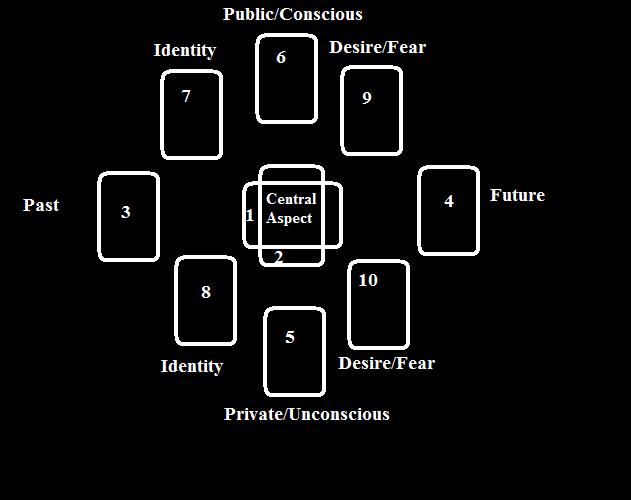
Personality Tarot Spread Layout
1. Central Characteristic: This card represents the most important part of someone’s personality; it is the card that best describes and sums up the the personality of the entire person. It is both the primary factor and the summary of the rest of the spread.

2. Influencing Characterstic: This card is the second most important aspect of someone’s personality, and influences, mitigates, or complements the Central Characteristic; in many ways it also the secondary characteristic of a person, and provides a second dimension to one’s personality, adding depth to it.

3. Influence of Past: This card sums up the influences that past events have had on one’s personality; memory is an important part of our personality, our desires, and our own identity. This card represents and shows the influence that this memory has had on a personality.

4. Goals of the Future: This card represents what one are striving to accomplish; another aspect of one’s personality is their drive, and what makes them motivated: that motivation and drive is represented by this card, which shows the thing that the person is striving to achieve, and their most important desire for the future.

5. Unconscious Thoughts and Motives: This card represents the unconscious thoughts and concerns of a person, and also represents this person’s motives. It answers the questions of “why do they do this?” as well as those of “what are they really thinking?”  This is their unconscious drive (rather than the conscious drive of Card 4), and represents the deepest aspects of their personality, hidden from themselves. This card also serves as the synthesis of cards 8 and 10.

6. Conscious Thoughts and Concerns: This card represents the person’s conscious thought. It helps one examine what the most important things are to this person, and represents their most pressing concerns, and what is most important to them at this time. This card also serves as the synthesis of cards 7 and 9.

7. Public Face: This card is the public aspect of one’s identity; this is how others perceive this person, and how their environment (including other people) affects them and notices them. This card is similar to Card 8 (second from the bottom of the Staff) on the Celtic Cross. This card represents how they want others to see them as well.

8. Private Face: This card represents the concept of self-identity and self-image, and shows how a person really thinks of themselves. This might line up with one’s public face, but often is at least slightly different. This card is similar to Card 7 (bottom of the Staff) of the Celtic Cross spread. This card shows how this person really feels about himself, and what they think their own identity is.

9. Public Desire: This card represents what one says they want; it is the stated hopes and fears of a person. This is what the person wants others to think they want and what they want others to think they are afraid of; this card represents those desires made public.

10. Private Desire: This card represents one’s true hopes and fears; their heart’s desire or their deepest, secret fear. These are the desires that people keep repressed and hidden – sometimes even from themselves – for various reasons. These are the inner passions and repressed terrors that often motivate people’s actions unconsciously.

Three of Swords: Sorrow

ThothRider-Waite

Sorrow: Betrayal, Inner Turmoil, and Loneliness

The Three of Swords. Sorrow. Sadness. Secrecy. Heartbreak. Betrayal. Loneliness. Inner turmoil. Chaos. Disillusionment. Perversion. The Three of Swords corresponds to the Sefirot of Binah; stability, the birthing ground, and the plane. Binah is where the energy of the Suit begins to take form and gain potential. In most of the suits, this position is positive, bu the Three of Swords has a distinctly negative connotation. In many ways, the Three of Swords is like Geburah (chaos of motion) come early. In the realm of the abstract, corruption and morally evil things come to the fore much more readily than in the realm of the physical: and so when the pure ideas of Swords finally reach the place where they can be born, they suffer negativity much more quickly. The abstract does not mix well with any notion of the material, and its potential, while great, is easily sullied by perversions of the mind.

And so, then, we have Sorrow. The abstract ideals of the mind, when realized, often fall far short of reality, and so then we give ourselves in to sorrow. Binah represents also duality, and when this duality is combined with the energy of Swords and its principles, is not what one expects; so the duality is betrayed, and heartbreak comes to the fore. This card is the sorrow that comes with the realization that the world is not perfect. Life is imperfect, and often brings despair. That is what this card stands for; the sadness that results from the realization that great principles cannot be applied effectively to the realities of the world, and so its potential is thwarted.

The duality betrayed leads not only to heartbreak, but to loneliness and secrecy as well; in this way this card represents the feelings one has when one’s ideal notions of a relationship are shattered. There is a sense of betrayal that accompanies the Three of Swords as well; the world (or other person) has wronged you somehow, and not lived up to your expectations; the Peace has been shattered, and Sorrow has taken its place. No more is there the inner tranquility and calm of the Two of Swords; the inner spirit is now in turmoil, and the calm has become grief.

The Rider-Waite illustration shows a heart being pierced by three swords, while rain pours down from dark clouds. This artwork very clearly illustrates the idea of heartbreak and betrayal, as well as sadness and dreariness. The Thoth art shows three swords, not crossed to defend the peace as in the Two of Swords, but rather all points at the same target: a flower. The flower of peace is being threatened, and the geometrical designs of the Two of Swords are now less regular and more curved. Dark stormclouds loom in the background. The flower is wilting and losing its petals; it is dying slowly. This card strongly gives off the idea that the universe has betrayed the ideals of peace; the world is imperfect.

In a reading, this card asks you to examine the roles of loneliness, sorrow, heartbreak, and other dismal states of mind in your life. Does it seem like the world is out to get you? Do things never go right? Are you in anguish inside? How have secrets been affecting you? Reversed, it asks you to look for this card in ways you might not expect; it reinforces the idea of Inner turmoil, maybe hidden from the outside. Is someone’s sorrow contained within them? Is your own sorrow hidden from yourself?

Doctor Who Season Premiere!

I watched it, and I was thrilled. It was a fantastic episode, and the Silence are fantastic aliens – they’re not Weeping Angels, but their concept is better than the Vashta Nerada, Moffat’s other big creation. Stephen Moffat is a superb writer, and he delivered a superb, funny, terrifying, and thought-provoking episode; I can’t wait to see part two! “The Impossible Astronaut” ended on quite a cliffhanger…

Two of Swords: Peace

ThothRider-Waite

Peace: Inner Tranquility, Putting Aside Differences and Conflict to Improve the Future, and Blocking Emotions

The Two of Swords. Peace. Calm. Inner Tranquility. Putting Aside Differences. Avoiding Conflict. Blocking Emotions. The Two of Swords corresponds to the Sefirot of Chokmah; the first manifestation of the seed of Kether, and the original harmony and power of creation. It is the energy and idea of the Suit of Swords given original harmonious form; it is the first appearance of logic and abstract thought and ideals. What better way to express abstract ideals of truth and justice than through the idea of Peace? By putting aside differences and avoiding conflict, thinkers can come together and help build the world, making it a better place. Peace allows for thought to grow, and is the result of the application of the principles associated with the Suit of Swords.

The card’s association with inner tranquility also is the representative card of the philosopher and thinker; those individuals who commonly exemplify the Suit of Swords. These logical thinkers must block out the influence of their emotions of their thought is to be true, and so often this tranquility is emotionless. This card embodies the mental state – the abstract ideas – associated with the suit of Swords with regards to oneself, and so is the mental harmony of Swords: that is, Peace.

The Rider-Waite illustration shows a woman sitting on a stone bench, blindfolded and holding two swords across her chest defensively. She is blocking herself from others, and is focused on herself and not her environment, as is seen from the blindfold. She is peaceful and calm, and also alone – she does not let her surroundings disturb her sense of calm. Behind her is the sea, which is also extremely calm. The Thoth art shows two crossed swords piercing the center of a flower and keeping it suspended and stable, while not actually breaking or destroying it; the background shows many angular geometrical patterns, emphasizing the stability and logicality of it all. Below and above this central motif are smaller swords. This card emphasizes the idea of calmness and tranquility, and self-examination and lack of conflict; the swords are not locked together to fight, but to make peace.

In a reading, this card asks you to examine your own mental state; are you calm internally? Are you blocking your emotions? It also asks you to look at your environment; is it free of conflict? Should you put aside your differences and work together with someone else to build a better future? Reversed, this card’s energies are present but hidden or twisted in some way; does a particularly rambunctious individual actually know internally where he stands? Is the banter and apparent conflict at your workplace really actually signs of putting aside differences and peace and well-being?

The Colour of Magic Movie/Special

I watched it yesterday while doing schoolwork, and it was okay. Watchable, but the movie adaption of Hogfather was much better. The Colour of Magic movie was more absurd, and the casting I thought was very good; Sean Astin (though he kept making me think of Samwise Gamgee) was a fantastic Twoflower, and David Jason was a superb Rincewind. The luggage was a wee bit different than how I pictured it, and played a much less prominent role in the film, which made me sad.

My main objection to the film was its deviations from the book, and what scenes it chose to portray. It left out a good chunk of things; such as flying on a cloud, waiting for rescue  in the Kingdom of Krull, the game of the Gods, the Temple of Bel-Shamharoth, and others. They chose to include my least favorite part, the Wyrmberg, which I felt could have been better replaced by Bel-Shamharoth’s Temple. In the end, I was unhappy with the plot changes the film-makers chose to make, and think they should have chosen something else to adapt, as opposed to trying to squeeze those two books into one movie. Doubtless for one who hadn’t read the books, the movie would have been good, though.

The other major objection I had was that the inter-wizard rivalry was given much more attention in the movie. And I don’t like Tim Curry as an actor, so having him play Trymon made me unhappy; he came across as actively malicious and evil in the movie, but in the books he’s just an OCD maniac. Also, on a parting note, Trymon in the movie looks a lot like a much older and angrier version of Joacim Cans (lead singer of the band HammerFall):

TrymonJoacim Cans

So, in summary, watch it if you haven’t read the books. If you have, it might be best to steer clear and watch Hogfather instead.

Babylon 5

I just finished Babylon 5. All I can really sat at first is… wow. That series blew my mind away. Unlike many reviewers on Netflix, I loved the pilot – and I loved Season One. Then Seasons Two made me reel in awe, and three and four had my mind on a whole different plane. Season Five went back down to between One and Two, but was still mindblowing. The sheer amount of work, creativity, genius, and inspiration that went into this is astonishing – incidents from seasons one and two had dire consequences in the final season, and the last episode – Sleeping in Light” – had me tearing up by the end, it was so moving. I’ve never felt so connected to the characters of any show before, or even any book series – I will truly miss them.

Never before have I ever also seen so much character development; each character changes drastically over the course of the show:

-A low-ranking captain becomes Humanity’s greatest hope for peace, and later ends up 1,000 years in the past to form the foundation of one of the Galaxy’s greatest civilizations.

-A war hero that is both hated and respected by his enemies and friends becomes a messiah who gives his life for the dream he has for the galaxy, and later ascends to another level of being.

-A comical, incompetent drunkard becomes a spiteful and vindictive power-hungry traitor, and then turns into a noble and courageous leader who gives his life to save his people.

-An angry, bitter, cynical, vengeful, crude ambassador becomes a spiritual guide for his people and changes the face of his whole civilization, and changes the very principles of the galaxy.

-A meek, kindhearted, and loyal ambassadorial aide becomes the womanizing emperor of one of the galaxy’s largest empires.

-An honorable, reformed, competent, loyal man becomes a traitor, devolves into his past vices, and then rises again as a reformer for good as a business leader.

-A naive, loyal, inexperienced ambassadorial aide becomes a wise and just inspiration for his people, and then turns on one he has the greatest respect for in a twisted act of love, ending his appearance in shame and a flight away from it all.

-A depressed, bitter, distraught young man becomes a noble hero, and then dies saving the only woman he ever truly loved.

-A hardline, impatient, no-nonsense officer becomes a wise, understanding, and compassionate leader of an intergalactic security force.

-A kind and caring man sworn not to hurt anyone becomes a drug abuser, who then becomes a freedom fighter and then a bureaucratic researcher.

-An angry individual who started a wear that almost wiped out an entire civilization comes to love those whom he almost destroyed, changes the shape of her people, and becomes a wise and just leader of the galaxy.

And there are many more. Never before have I seen such superb character development and such an intricate plot with as few contradictions as in Babylon 5. Truly, this series is the best television show I have ever seen, and will influence me in a lot of things. It has made me think about questions I haven’t thought about, and is heavy with weighty themes and ponderings. I recommend this show to anyone, really – it was just that good.